Twenty-six endpoints across twenty-one providers currently serve DeepSeek-V4.1-Flash (1017) on Artificial Analysis. On the surface, that looks like normal tiering: Baseten (FAST) finishes an Intelligence Index run in 2.6 minutes for $2.32, while DeepSeek’s own API takes 13.1 minutes for $0.60, and DeepInfra takes 18.9 minutes for $0.19. Across the full field, price per task varies by 114.7×.
Below the top line, the numbers are harder to defend. Fast low-concurrency inference is running into a latency floor set largely by synchronization, coding agents leave fast GPUs idle roughly three-quarters of the hour, and by my arithmetic the fastest public endpoints are priced below what their GPUs cost at low concurrency. Two of the three fastest also have no published accuracy check, and several cheaper endpoints post high error rates.
The same math hits GPU neoclouds, whose financing assumes that hardware holds rental value for four to six years and that landlords can expand margins through managed inference. Vera Rubin’s lower fast-tier costs, faster kernel bring-up on new chips, and frontier labs integrating their own silicon and developer tools work against both assumptions.
1. Normalizing the 2,060 Token/s Benchmark—and Hitting the Sync Wall#
The recent wave of “ultra-fast” inference headlines kicked off when Baseten open-sourced deepseek-ultrafast, reporting 2,060 tokens per second on eight B300s (2.71 ms per decode step) and 1,740 tokens per second on four GB300s (3.30 ms per step).
Those numbers come from a best-case configuration: reasoning turned off, six draft tokens per step via DSpark speculative decoding, and a single repetitive prompt (“implement the tetris game. output HTML code directly”). Generating Tetris HTML is about as predictable as code gets, producing an average acceptance length of 5.6 tokens per step.
On realistic coding-agent workloads (InferenceX SPEED-Bench, with reasoning enabled and five draft tokens), DeepSeek-V4.1-Flash’s DSpark head averages 3.51 accepted tokens per step (4.07 with reasoning off). Because step latency depends on executing the draft loop rather than how many tokens pass verification, throughput scales linearly with acceptance length:
| Engine & Hardware | Raw Claim (Tetris, 5.6 AL) | Step Time | Normalized Speed (SPEED-Bench, 3.51 AL) |
|---|---|---|---|
Baseten (deepseek-ultrafast) — 8× B300 | 2,060 tok/s | 2.71 ms | 1,295 tok/s |
Baseten (deepseek-ultrafast) — 4× GB300 | 1,740 tok/s | 3.30 ms | 1,064 tok/s |
| SGLang + NVIDIA Megakernel — 4× GB300 | — | 3.61 ms | 952 tok/s |
| muLLM v0.4.1, internal NVIDIA (4 prefill / 8 decode GB300s) | — | 2.45 ms | 1,395 tok/s |
| TensorRT-LLM, internal NVIDIA branch — 8× GB300, aggregated (attention TP8, MoE TP4 × EP2) | — | 2.29 ms | 1,462 tok/s |
| TileRT (4 prefill / 8 decode GB300s) | — | — | 1,515 tok/s |
| TileRT (4 prefill / 24 decode GB300s) | — | — | 1,724 tok/s |
| TileRT (4 prefill / 8 decode MI355Xs) | — | — | 1,333 tok/s |
| vLLM (8 prefill / 8 decode VR200s) | — | — | 1,724 tok/s |
| Baseten — 4× Vera Rubin (VR200) | ~2,500 tok/s (implied ~4.75 AL) | 1.9 ms | ~1,850 tok/s |
Baseten’s rows are 3.51 accepted tokens divided by its published step time; Baseten has no InferenceX run. Every other row is the speed InferenceX charts for a single user: p90 interactivity over a full AgentX trace replay at concurrency 1 (the muLLM and TensorRT-LLM points are internal NVIDIA runs on the same benchmark).
Once normalized—and before accounting for the fact that real agent sessions carry much longer contexts than a standalone Tetris prompt—Baseten’s engine sits roughly 12% ahead of SGLang’s megakernel on four GB300s.
Almost all of the top entries cluster between 1,300 and 1,750 tok/s, whether running on 4 GB300s, 28 GB300s, or 8 VR200s. The model’s own weight sizes show why single-user speed is running out of headroom.
Each decode step with five draft tokens runs six tokens through 40 target layers, followed by three DSpark draft layers over a five-token block. That step reads 27 to 39 GB of weights:
- 16–27.5 GB in routed MoE experts (each token selects 6 of 384 experts at 19.9 MB each, touching roughly 20 to 34.5 distinct experts per layer across 40 layers)
- 5.0 GB in attention weights
- 1.7 GB in shared experts, routers, and hyper-connection weights
- 1.3 GB in the LM head (read twice, for target and draft) plus ~1.5 GB in draft layers
Across four GB300s (6.8–9.7 GB per GPU at 8 TB/s), memory bandwidth accounts for 0.85 to 1.21 ms per step. The remaining delay is pure sequential dependency. Each layer executes roughly 13 serial operations—hyper-connection mixing, Q/KV projections, the indexer and top-512 selection, sparse attention, two output projections, two all-reduces, routing, and expert GEMMs—followed by five sequential Markov-head rounds in DSpark that exchange data across GPUs. In total, one step triggers roughly 560 dependent kernel stages and 97 collectives.
Assuming roughly 1 µs per dependent stage (grid barrier plus first memory trip) and 2.5 µs per small all-reduce (±0.3 ms uncertainty), sequential synchronization imposes a ~0.8 ms latency floor independent of memory bandwidth. Overlapped with weight reads, four GB300s hit an absolute hardware floor of 1.3 to 1.7 ms per step (~2,200–2,900 tok/s theoretical maximum). Over the autumn, SGLang’s megakernel (3.61 ms) and Baseten’s engine (3.30 ms) pushed four-GPU efficiency from roughly 15–20% of that theoretical floor in September (7.98 ms) to 40–51% today, leaving roughly a 2× kernel optimization ceiling left. Baseten’s own measurements line up with the synchronization picture: on GB300, a chain of fused kernels with programmatic dependent launch (PDL) runs one layer in about 43 µs, roughly 1.7 ms for 40 layers, while a single-layer megakernel with grid barriers was slower, at 50 to 57 µs, because the barriers cost more than they saved.
Adding GPUs does not break that ceiling. Scaling from four to eight GPUs halves the bytes each GPU reads, yet all 560 dependent stages and 97 collectives remain, pinning the eight-GPU floor around 0.8 to 1.0 ms, which is why vLLM on eight decode VR200s reaches 1,724 tok/s, the same as TileRT’s best on 24 decode GB300s. A faster chip does move it. Baseten reports 1.9 ms per step on four VR200s, 1.74× its GB300 step, from roughly 2.5× the HBM bandwidth (about 20 TB/s against 8) and finer-grained synchronization that lets each kernel start tile by tile as its inputs land. At InferenceX’s 3.51 tokens per step that is about 1,850 tok/s, the fastest single-user number here, still bounded by the same dependent chain.
Why Speed Leads Don’t Last#
On these numbers, Baseten has no inference moat. TileRT, an MIT-licensed open-source runtime from tile-ai, reaches 1,515 tok/s on GB300 and 1,333 tok/s on AMD’s MI355X in InferenceX’s single-user runs (each with 4 prefill and 8 decode GPUs), both faster than Baseten’s normalized 1,064 on four GB300s and 1,295 on eight B300s. The extra speed on Vera Rubin (vLLM’s 1,724 on eight decode VR200s, Baseten’s normalized ~1,850 on four) comes from the chip, not the software: Baseten attributes its own 1.74× jump from GB300 to VR200 to roughly 2.5× the HBM bandwidth and finer-grained synchronization, which every engine gets on the same hardware. SGLang’s open megakernel sits within 12% on the same four GB300s, and Baseten says it is submitting anything general from its own work upstream to SGLang. That megakernel is NVIDIA’s own work (sgl-nvidia-mega), and it shares its kernel lineage with muLLM, an internal NVIDIA framework. muLLM v0.4.1 already reaches 1,395 tok/s in a full 3,600-second AgentX run (4 prefill and 8 decode GB300s), ahead of TileRT’s 1,333 on MI355X on the same p90 metric. The fastest engines for this model are written by the GPU vendor, and their kernels are flowing into open source. A serving startup is competing against NVIDIA’s engineers on NVIDIA’s hardware.
None of this is new for Baseten, which has published six “fastest” posts in a year: GPT-OSS in October 2025, Kimi K2.5 in February, GLM-5 twice in March, and GLM-5.2 as “the world’s fastest API” in June, then “the new fastest API” a month later. The posts make the case themselves. The GPT-OSS post says that 400 to 500 tokens per second “was leading performance at launch, today it would be middle”; the second GLM-5.2 post quotes “peak speeds of 280 tokens per second and average speeds around 100”; and the 1,792 tok/s VibeQwen headline was measured on “speculator-friendly text”. A speed lead in this market lasts weeks, and the headline number is usually a best case. Read closely, the posts are also vague. Across those six posts and the GLM-5.2 Fast launch post, none gives an acceptance length or rate as a number (they say “high acceptance rates”), none gives a decode step time, and only the GPT-OSS post says how many GPUs stand behind the headline (eight B200s); the rest say “NVIDIA Blackwell”. What the posts do describe is the standard kit: running TP8 on eight B200s with TensorRT-LLM and an EAGLE-3 draft head (GPT-OSS); converting INT4 weights to NVFP4 with NVIDIA ModelOpt (Kimi K2.5); and pairing NVFP4, KV-aware routing, NVIDIA Dynamo prefill-decode disaggregation, and MTP heads (GLM-5.2). Every item on those lists is an NVIDIA library or a feature that vLLM and SGLang already ship. The open-source deepseek-ultrafast README, with its step times, acceptance length, and exact prompt, is the exception, and it is the only reason this essay can normalize Baseten’s speed at all.
Even the speed axis is soft. Single-user speed is charted from time per output token, and client TPOT is computed as (end-to-end latency − TTFT) ÷ (output tokens − 1). SGLang just merged a change that streams a disaggregated decode request’s first token together with its first decode step instead of right after prefill. Its own description says the old behavior charged every request’s TPOT with a gap of about 104 ms before the second token, while each steady 32-token streaming chunk on the same 32-GPU decode deployment took about 92 ms. A decode server that samples the first token in its own first decode step has no such gap. The change moves time out of TPOT and into TTFT without changing end-to-end latency at all. Other decode servers already work this way, which is the PR’s stated motivation, so providers ranked on tokens per second are very likely benefiting from the same accounting already. An end-to-end metric, like Artificial Analysis’s time per task in section 3, would be the fairer axis.
2. The Coding-Agent Utilization Trap and the Batching Paradox#
Even at 1,000+ tok/s, fast inference runs into an external bottleneck: coding agents spend most of their wall-clock time not calling the model.
InferenceX’s agent benchmark (agentx-harness) replays recorded coding-agent sessions with original wall-clock “think time” preserved—the interval while the agent runs shell commands, compiles code, edits files, and waits on test suites (with idle gaps capped at 10 seconds). On four GB300s at concurrency 1, each request averages 276,000 input tokens (97.5% served from prefix cache) and 1,700 output tokens:
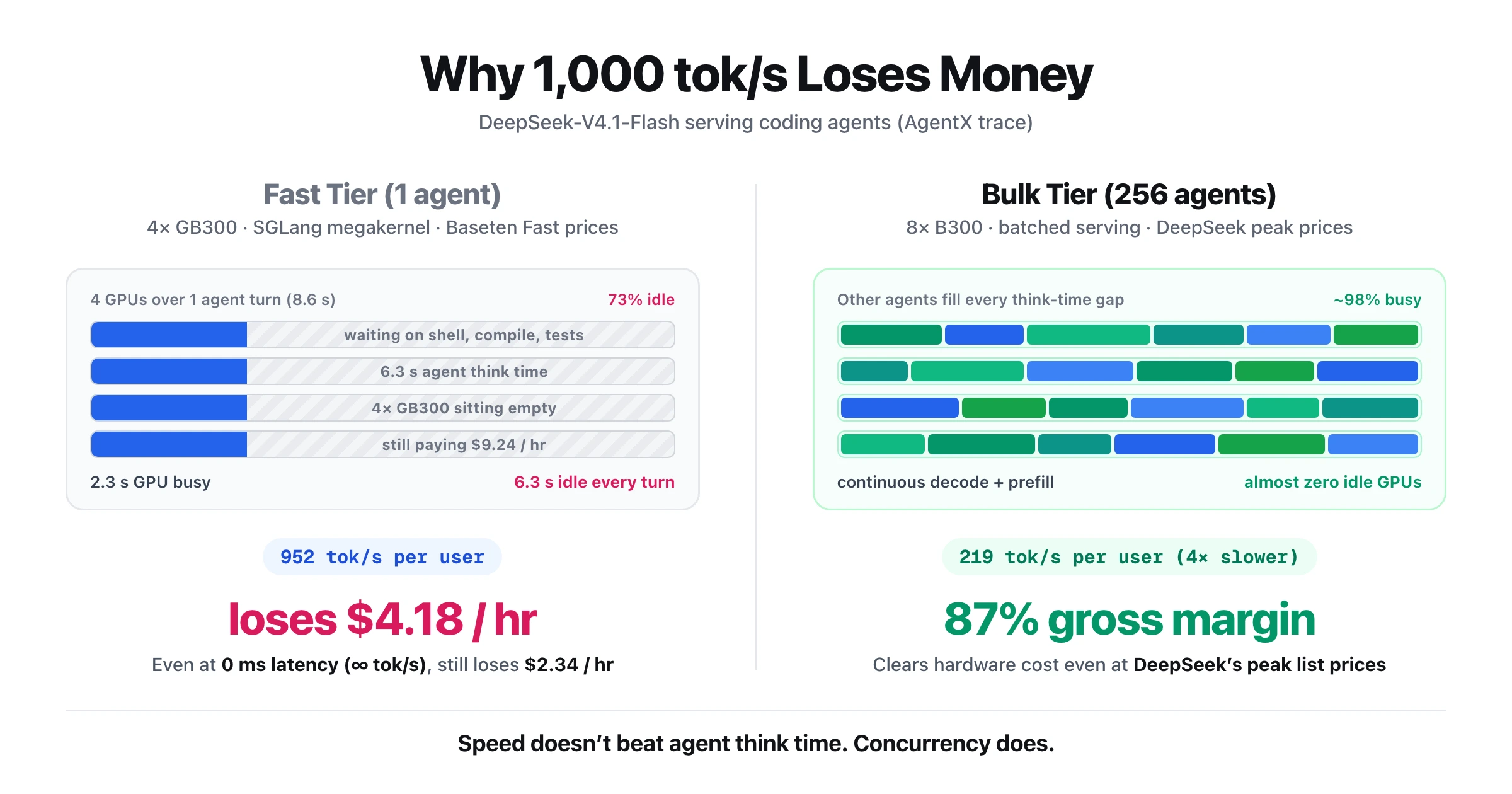
- GPU busy time per request: ~2.3 seconds (~0.5s time-to-first-token + ~1.75s decode)
- Average agent think time: 6.3 seconds
- Resulting GPU idle time: 73% (65% to 81% across all tested hardware)
Using SemiAnalysis’s estimated owner cost of $2.31/GPU-hour for GB300 ($9.24/hour for four GPUs) and $2.26/GPU-hour for B300 ($18.08/hour for eight GPUs), every fast configuration loses money serving one agent at a time:
| Endpoint / Setup | Requests / Hr (1 Agent) | Hourly Revenue | Hardware Owner Cost | Hourly Profit / (Loss) |
|---|---|---|---|---|
| SGLang on 4× GB300, billed at Baseten Fast prices ($0.60 / $0.014 / $2.40) | 420 | $5.06 | $9.24 | ($4.18) |
| Baseten engine on 4× GB300, Baseten Fast prices | 427 | $5.15 | $9.24 | ($4.09) |
| Baseten engine on 8× B300, Baseten Fast prices (B300 trace) | ~452 | $5.13 | $18.08 | ($12.95) |
| SGLang on 4× GB300, billed at DeepSeek’s weekly average ($0.181 / $0.0036 / $0.725) | 420 | ~$1.50 | $9.24 | ($7.74) |
| Hypothetical 0 ms Latency on 4× GB300 (Baseten Fast pricing) | ~570 | ~$6.90 | $9.24 | ($2.34) |
The 8× B300 row bills slightly less per request than the GB300 rows because InferenceX’s B300 run replayed slightly shorter requests (about $0.0114 each against $0.0121). DeepSeek’s API drops 50% off-peak for 133 of the week’s 168 hours, averaging 60% of its $0.30 / $0.006 / $1.20 peak list prices—producing roughly $1.50/hour against a $9.24/hour hardware bill. More importantly, even if decoding and time-to-first-token magically fell to zero milliseconds, a coding agent’s 6.3-second tool-execution delay caps throughput around 570 requests per hour ($6.90 at Baseten Fast prices, ~$3.30 at DeepSeek peak prices)—still underwater against hardware ownership cost. Rubin’s faster single-user speed doesn’t change this: one agent on four VR200s fits about 464 requests an hour and bills about $5.60 at Baseten Fast prices, against $14.44 an hour of GPUs.
Why Batching Fails Fast Tiers#
Providers obviously stack multiple concurrent agents onto the same GPUs to absorb that 73% idle window. At DeepSeek’s peak pricing and owner hardware cost, four B200s, B300s, or GB300s break even around 16 concurrent agents (4 per GPU), or roughly 8 per GPU at prevailing rental rates. At high concurrency, bulk inference becomes extraordinarily profitable:
- 8× B300 @ 256 agents: Delivers 219 tok/s (P90) at an 87% gross margin against DeepSeek peak prices.
- 64× GB300 disaggregated (Dynamo + vLLM) @ 10,877 agents: Pushes serving cost down to $0.0007 per 1M tokens, almost all of them cache hits (versus DeepSeek’s $0.006 cached-input list price).
- Across InferenceX, virtually every hardware configuration clears 60%+ margin once it sustains ~12 concurrent agents per GPU at ~98% uptime.
The problem is that low-latency megakernels break down under batching. On four GB300s, SGLang’s megakernel slows from 952 tok/s at concurrency 1 to 562 tok/s at concurrency 4—a 41% speed cut per user in exchange for just 1.33× total output. vLLM on four B300s holds 833 tok/s at concurrency 4, yet total output rises only 1.42× as 276k-token prefills contend for compute.
Utilization cuts the same way: halve steady utilization on the four-GB300 fast endpoint above, and its hourly loss worsens from $4.09 to $6.67.
How Much Demand Actually Exists#
OpenRouter publishes daily token counts per model and per provider, which puts a number on the demand side. Averaged over November 10 to 16:
| Model on OpenRouter | Prompt Tokens / Day | Cached | Completion Tokens / Day | Requests / Day |
|---|---|---|---|---|
| DeepSeek-V4.1-Flash (1017 + 0910 versions) | 10.78T | 92% | 168B | 211M |
| GLM-5.3 | 0.52T | 91% | 9.3B | 11.7M |
| Kimi K3.1 Pro | 0.46T | 92% | 5.0B | 5.7M |
DeepSeek-V4.1-Flash is by far the most used open model here, and its whole OpenRouter volume, 10.95T tokens a day across 39 providers, is small next to a single efficient deployment:
- One deployment’s worth: InferenceX’s cheapest 32-GPU VR200 point serves 8.28T tokens a day, so all of OpenRouter’s DeepSeek-V4.1-Flash traffic would fit on roughly 40 to 90 Rubin GPUs (by total tokens and by output tokens), or about 130 to 280 GB300s at GB300’s cheapest point.
- At DeepSeek’s own efficiency: billed at DeepSeek’s off-peak prices, that traffic is worth about $252k a day, which DeepSeek’s off-peak revenue of $38 per GPU-hour (section 5) covers with about 280 GPUs. At peak prices both the bill and the revenue per GPU double, so the count stays the same. DeepSeek’s single DeepInfer cluster serves 155T tokens a day, about 14 times all of OpenRouter’s volume for the model.
- Split 39 ways, unevenly: DeepSeek’s own endpoint (20.1%) and DeepInfra (15.3%) carry over a third of the OpenRouter traffic for the 1017 version, leaving the other 37 providers in single digits. Baseten carries 0.4%, about 37B tokens a day, which is a quarter of what one 8× B300 node with 256 agents serves on InferenceX.
- And this is the best case: GLM-5.3 and Kimi K3.1 Pro each see about a twentieth of DeepSeek-V4.1-Flash’s OpenRouter volume.
What the middle actually earns. Multiplying each provider’s OpenRouter volume by its own listed prices (and assuming its token mix matches the model’s for the 1017 version alone: 93.5% of prompt tokens cached, 1.4% of all tokens output) gives a rough revenue estimate for DeepSeek-V4.1-Flash-1017 alone:
| Provider | Share of Traffic | Tokens / Day | Output Price / 1M | Est. Revenue / Day | Est. Revenue / Year |
|---|---|---|---|---|---|
| DeepSeek | 20.1% | 1,751B | $0.60 | $35,934 | $13.12M |
| Together | 7.7% | 669B | $1.20 | $27,471 | $10.03M |
| DeepInfra | 15.3% | 1,339B | $0.29 | $17,386 | $6.35M |
| Fireworks | 2.3% | 200B | $1.80 | $12,289 | $4.49M |
| Wafer | 7.9% | 692B | $0.50 | $11,764 | $4.29M |
| Relace | 5.4% | 474B | $0.50 | $8,181 | $2.99M |
| DigitalOcean | 3.6% | 313B | $0.72 | $7,703 | $2.81M |
| CoreWeave | 1.7% | 144B | $1.20 | $5,916 | $2.16M |
| Morph | 3.9% | 338B | $0.52 | $5,221 | $1.91M |
| Prime Intellect | 3.1% | 268B | $0.70 | $3,881 | $1.42M |
| Baseten | 0.4% | 37B | $1.20 | $1,547 | $0.56M |
| River | 1.1% | 93B | $0.35 | $1,094 | $0.40M |
| Nebius | 0.1% | 11B | $1.20 | $455 | $0.17M |
| The other 26 providers combined | 27.5% | 2,397B | $60,864 | $22.2M | |
| All 39 providers | 100% | 8.73T | $199,706 | $73M |
All 39 providers together earn about $73M a year from this model on OpenRouter, and 20 of the 39 earn under $1M. Prime Intellect’s 3.1% share, a respectable slice of the most-used open model, comes to about $3,900 a day. At the same blended price per token, DeepSeek’s single 155T-token-a-day cluster would bill about $1.3B a year, roughly 18 times all 39 of these providers combined. These are OpenRouter-only estimates for one model, not company revenue: direct API traffic, other models, dedicated deployments, and training revenue are all outside them.
Providers will answer that OpenRouter is price-sensitive router traffic, and that their real business is direct APIs and dedicated enterprise deployments. Direct serverless traffic may well be several times larger, but even at several times this volume, a market where two providers take over a third and 37 split the rest still leaves the long tail far below the concurrency where the cheap-token numbers apply (DeepSeek itself caps single-account Flash concurrency at 2,500 requests). Dedicated deployments don’t escape the problem either: they trade the shared-API utilization problem for the single-tenant idle-GPU and services problem in section 5.
3. What the Artificial Analysis Leaderboard Actually Reveals#
Examining all 26 endpoints across 21 providers for DeepSeek V4.1 Flash on Artificial Analysis shows how that economic trap plays out in the live market:
| Provider / Tier | Time / Task | Cost / Task | First Answer (s) | Cache Hit Rate | Error Rate | Accuracy Index |
|---|---|---|---|---|---|---|
| Baseten (FAST) | 2.6 min | $2.32 | 7.95s | 92% | 0.0% | 100% |
| LithosAI (ULTRA CHAT) | 2.7 min | $0.90 | 7.79s | 96% | 0.0% | n/a |
| Fireworks (ULTRA FAST) | 3.2 min | $21.80 | 9.82s | 74% | 0.0% | n/a |
| Inco (FAST) | 4.8 min | $6.36 | 16.87s | 69% | 0.0% | 100% |
| Bitdeer AI | 6.6 min | $1.03 | 22.63s | 81% | 0.0% | 100% |
| DigitalOcean | 8.5 min | $0.45 | 30.63s | 100% | 0.0% | 100% |
| CoreWeave | 9.1 min | $2.37 | 29.92s | 78% | 1.9% | 101% |
| Scaleway | 10.7 min | $14.54 | 46.25s | 42% | 3.5% | 82% |
| GMI | 11.3 min | $0.30 | 31.92s | 99% | 16.2% | 101% |
| DeepSeek (Official) | 13.1 min | $0.60 | 40.00s | 98% | 0.0% | 101% |
| DeepInfra | 18.9 min | $0.19 | 58.91s | 99% | 0.0% | 101% |
| Nebius | 20.1 min | $3.27 | 66.09s | 68% | 0.0% | 98% |
Three patterns stand out:
- The public neoclouds’ managed endpoints don’t stand out. Part of the investment case for GPU neoclouds is moving up the stack from bare-metal rentals to high-margin managed inference APIs. Yet Nebius is simultaneously the second-slowest endpoint out of 26 (20.1 min, 66.09s first answer) and among the priciest ($3.27/task—5.4× DeepSeek and 17× DeepInfra), while posting a weak 68% cache hit rate and 98% accuracy. CoreWeave charges $2.37/task—more than Baseten FAST—while running 3.5× slower (9.1 min), hitting only 78% cache, and dropping 1.9% of requests. On this benchmark, neither shows a software edge over the pure-play specialists. The general-purpose clouds don’t make a better case. DigitalOcean posts a clean 100% cache hit rate and 0% errors, but that is all it has: it ranks 10th of 26 on speed (8.5 min per task, 3.3× slower than Baseten FAST), only 5th on price ($0.45 per task, 2.4× DeepInfra’s $0.19), and users wait about 31 seconds for the first answer token. It sells the same open weights as twenty other providers, too slow to win the fast tier and too expensive to win the cheap one, which is exactly the middle position that gets squeezed first when prices fall.
- Leaderboard positions don’t show the economics. Fast endpoints work largely as customer-acquisition billboards that put a top-three badge in front of developers and investors. Either a provider prices defensively in case real traffic arrives, like Fireworks (ULTRA FAST) at $21.80/task with no published accuracy index, or it sells at prices that, by the arithmetic in section 2, cannot cover the GPUs at low concurrency (Baseten FAST at $2.32). LithosAI (ULTRA CHAT) at $0.90 also has no published accuracy index, so its speed can’t be compared on equal terms.
- Cache discipline and reliability vary a lot. Because long-context coding prompts average ~97.5% cached prefixes, poor prefix-cache routing raises the customer’s bill sharply: Scaleway posts a 42% cache hit rate, an 82% Endpoint Accuracy Index (18 points below reference), and a $14.54 task cost, while GMI prints a $0.30 price tag alongside a 16.2% failure rate.
4. Vera Rubin and the Accelerating Obsolescence Loop#
If Blackwell struggles to make money anywhere near 1,000 tok/s, Vera Rubin (VR200) changes the shape of the entire cost curve. Despite an estimated owner cost 56% higher per hour than GB300 ($3.61 vs. $2.31/GPU-hour), Rubin’s cost advantage compounds sharply as target per-user speed rises:
| Target Per-User Speed (P90) | GB300 Cost / 1M Tokens | Vera Rubin Cost / 1M Tokens | Rubin Advantage |
|---|---|---|---|
| 200 tok/s (bulk) | $0.0007 | $0.0003 | 2.3× cheaper |
| 500 tok/s (mid-fast) | $0.0103 | $0.0008 | 12.9× cheaper |
| 700 tok/s (fast) | $0.0258 | $0.0019 | 13.6× cheaper |
At the top end, an 18-GPU VR200 deployment in a 1P4D layout (one prefill worker on 2 GPUs and four 4-GPU decode workers) serves 260 concurrent agents at 1,031 tok/s (P90) while clearing a 60% margin at DeepSeek’s peak list prices. Rubin makes the fast coding-agent tier profitable at speeds where Blackwell does not clear break-even.
Why Older GPUs Depreciate Faster Now—Not Slower#
Neocloud underwriting models generally assume smooth, multi-year GPU amortization—often pointing to the fact that H100 one-year contracts bounced off their ~$1.70/GPU-hour October 2025 low back toward $2.35–$2.80 in 2026, while Silicon Data’s B200 ($6.64/GPU-hr) and B300 ($7.56/GPU-hr) rental indexes are still rising.
That assumption misses two shifts:
- Model-hardware co-design strands prior generations quickly. A100s lack even FP8 support while frontier checkpoints now ship in FP4 (DeepSeek-V4.1-Flash, Kimi K3.1, and Inkling 2 Small in native NVFP4), and the megawatts, cooling, and rack space they occupy are worth more running newer silicon. Hopper (H100/H200) is following the same path: models are now trained for newer precisions through model-hardware co-design, which makes back-porting slow and uneconomic, and few buyers want new multi-year Hopper commitments.
- The software bring-up buffer is shrinking. Blackwell’s thin early kernel support gave Hopper a longer useful life than its specs alone would have. This time, Vera Rubin already has open-source results: InferenceX’s VR200 points run on Dynamo and vLLM before public clouds deploy it in volume. AI-assisted kernel work is a large part of why bring-up is faster this generation.
That acceleration cuts directly into neocloud balance sheets. When Blackwell faces a 13×–14× cost disadvantage at fast agentic tiers as soon as Rubin ships in volume (with early 60-month Rubin pre-orders starting near $11.05/GPU-hour), tenants locked into 2026 Blackwell contracts will face brutal repricing pressure at renewal—just as H100 rental rates fell from $8+/hour in 2023 to a one-year contract low of about $1.70 two years later.
5. Why Software, Service, and “GPUs in America” Don’t Form a Moat#
Beyond the hardware cycle, almost none of the middle layer has a technical moat, across both inference APIs and GPU neoclouds.
Day-zero kernel commoditization#
NVIDIA, AMD, and Google push optimized kernels straight into open-source vLLM and SGLang at model launch. Standalone compiler startups and proprietary serving engines fight over edges like Baseten’s ~12% lead over SGLang, already beaten by open-source TileRT, absorbed upstream within weeks, and dwarfed by silicon leaps like Rubin’s 13× at fast tiers.
The “GPUs in America” fallacy on open weights#
Model originators like DeepSeek own a coherent economic loop—architecting models around high-concurrency batch serving, capturing massive captive domestic demand in China, and earning real margins as the native provider. DeepSeek’s own DeepInfer deployment Q&A says that a single V4.1 Flash cluster serves 155 trillion tokens a day with overall revenue of $38 per GPU-hour at the off-peak price. That is about 30 times what one fast agent earns per GPU on four GB300s even at Baseten Fast prices ($5.06 an hour over four GPUs, about $1.27). The same document puts the production decode operating point at about 60 concurrent sequences per GPU on 64-to-128-GPU expert-parallel supernodes, which its own table puts at about 14,500 tokens per second per GPU, or roughly 240 tokens per second per user. DeepSeek did the same thing in its February 2025 V3/R1 report, where users got 20 to 22 tokens per second and the serving fleet shrank at night to hand GPUs to research and training. That high-concurrency, elastic-utilization operating point is the only unit-economics model that pays.
By contrast, the twenty other providers hosting identical DeepSeek weights mostly have one real differentiator, and for the U.S. ones it is physical racks inside the United States. With zero proprietary model IP and zero native distribution, they end up racing one another toward DeepInfra’s $0.19 floor.
Why enterprises reject shared open APIs, and why dedicated deployments trap providers#
A customer can’t easily check how a shared open-weight endpoint quantizes the model or what it does with prompt logs, so serious enterprises have good reason to distrust shared endpoints and ask Baseten, CoreWeave, or Nebius for managed single-tenant deployments. Yet dedicated deployments create two structural headaches.
The first is low utilization. An isolated enterprise cluster serving a few agents can sit idle ~75% of the hour during agent think time, forcing the customer to pay far more than closed frontier APIs.
The second is linear go-to-market and self-cannibalizing service. Supporting isolated deployments requires expanding forward-deployed solutions engineers alongside every enterprise account. Worse, when those engineers succeed in optimizing batching and utilization to make the client happy, they shrink the customer’s GPU bill—directly cannibalizing the vendor’s compute revenue. Unlike pure SaaS, a business built on relationship GTM and high-touch optimization is fundamentally an IT managed-services shop, which markets usually value like services rather than software.
Upstream workflow ownership and subsidized demand#
A lot of today’s agentic token volume is inflated by venture- and lab-subsidized flat-rate coding subscriptions. Meanwhile, the products that actually own developer distribution—IDEs and agent harnesses like Claude Code, Cursor, Codex, GitHub Copilot, and Gemini—hold the user’s repo context and billing relationship. They can route background sub-agents dynamically to whichever backend clears tokens at $0.19/task, or absorb workloads onto proprietary TPUs and frontier clusters, leaving standalone inference wrappers out of the customer relationship.
Post-Training Companies Want to Own the Whole Loop#
The closest thing the middle layer has to a moat is owning the customer’s weights, and both sides of the market are now racing for it. RL and post-training companies are adding inference. Applied Compute, founded in 2025 by former OpenAI researchers, launched an agent cloud that combines training, inference, and continual improvement; it says its inference serves more than 1T tokens a day and that 40% of its customers use it for both. River AI, which raised $1.1B across its seed and Series A in June 2026, describes its API as training, reinforcement learning, and production inference in one system, and bills training and inference per token rather than per GPU-hour. Prime Intellect went from RL environments and hosted training to an inference API (3.1% of OpenRouter’s DeepSeek-V4.1-Flash traffic), and Thinking Machines added OpenAI-compatible inference to Tinker. Inference providers are moving the other way: Fireworks sells reinforcement fine-tuning, Together launched Together Post-Training in October 2026, Baseten launched its Loops RL SDK, CoreWeave bought OpenPipe and launched serverless RL, and Nebius pitches post-training on Token Factory’s own production traffic. Relace and Morph sit in the middle, training their own coding-agent models with RL and serving them next to open models.
The logic is lock-in: weights trained on a provider’s stack are easiest to serve there, and a loop where production traffic becomes training data makes switching expensive. It collides with the utilization problem, though. A custom model served on its own GPUs is a single-tenant deployment with the same idle hours as any other. The version that escapes it is LoRA adapters on a shared base model, which River and Tinker both use, because many customers’ custom models can then be batched on the same GPUs. Per-token billing like River’s moves the utilization risk onto the provider, which only pays if it can batch many tenants. And the scale remains small: Applied Compute’s self-reported 1T tokens a day is roughly a tenth of OpenRouter’s DeepSeek-V4.1-Flash volume and 1/155 of one DeepSeek cluster. Its $100M run rate shows that custom post-trained and RL workloads bill far more per token than OpenRouter’s Flash prices, which would yield only about $8M a year at 1T tokens a day; capturing those margins without multi-tenant LoRA adapters still pushes providers straight back into single-tenant idle GPU time.
6. Where the Contraction Lands: Separating Power From Silicon#
GPU inference and neocloud operators carry massive fixed debt, lease obligations, and power commitments.
A contraction will hit different layers of the stack unevenly:
- Who holds structural leverage:
- Frontier labs and hyperscalers with custom silicon (Google TPUs, OpenAI/Microsoft, Anthropic/AWS) control model-to-chip co-design, capture the highest-intelligence reasoning tasks that enterprises refuse to trade down on, and serve ultra-cheap distilled tiers on massive shared scale.
- Official open-weights originators (DeepSeek, Z.ai, Moonshot AI, Alibaba) hold captive regional distribution and native architectural tuning.
- Lean high-utilization commodity routers (DeepInfra-style) run near-100% cache hit rates, ruthless multi-tenant batching, and minimal enterprise GTM bloat, surviving on thin spreads at huge volume.
- Power-first infrastructure landlords (Layer 0/1) who control genuinely scarce energized megawatts and 2027–2029 grid interconnects backed by creditworthy Big Tech take-or-pay leases—since grid queues remain a multi-year physical bottleneck even when silicon turns over.
- Who gets squeezed:
- Moatless API wrappers renting third-party GPUs to resell commoditized open weights while chasing Artificial Analysis speed badges.
- Leveraged GPU-rental neoclouds holding Hopper and early Blackwell debt without Tier-1 hyperscaler credit backstops, relying on flat GPU residual curves and unproved “managed inference” software upside right as Rubin and Day-Zero open-source bring-up compress the life of every preceding chip generation.
The YC cohort#
YC alone has funded at least 29 inference-infrastructure startups across serving APIs, tooling, compilers, and chips (listed at the bottom). Aside from two acquisitions (Replicate, OpenPipe), one shutdown (Mystic), and the widely used local runtime Ollama, only three register meaningful OpenRouter volume for DeepSeek-V4.1-Flash: Wafer, Relace, and Morph, which together serve 17% of it, at or below DeepSeek’s own price. Not every company on the list is trying to be an API provider (Luminal builds a compiler, Shadeform a GPU marketplace, Tinfoil confidential inference), but none of the other 22 shows up as a serving business with measurable traffic yet, and most are two-to-five-person teams. Even the leaders are small: Wafer’s entire OpenRouter volume, about 0.7T tokens a day, is under a tenth of one 32-GPU Rubin deployment. And none of the 29 lists running production inference at a closed frontier lab such as OpenAI or Anthropic in its founders’ YC bios; most of these companies are learning large-scale serving on the job, against providers that have done it for years. If there were a liquid way to short seed-stage startups, that directory page alone would fund a retirement.
Assumptions & Caveats#
- Synchronization floor: The ~1 µs per-stage and ~2.5 µs per-collective figures (along with routed-expert overlap ranges) are analytical estimates from the model’s weight sizes rather than low-level hardware profiler traces, carrying roughly ±0.3 ms variance.
- Trace & cost baselines: Agent trace economics rely on InferenceX’s public
agentx-harnesstrace set (10s idle cap, ~98% steady-state uptime assumption) and SemiAnalysis’s GPU owner-cost baselines; production traffic may be burstier (worsening utilization) or concentrated inside mega-platforms with enough steady volume to carry fast tiers as loss leaders atop bulk traffic. - Endpoint comparisons: Baseten’s normalized speeds use its published step latencies rather than independent replication, and Artificial Analysis provider metrics reflect the October–November 2026 snapshot across each endpoint’s tested configuration.
Sources#
- deepseek-ultrafast (Baseten)
- Baseten speed posts: GPT-OSS, Kimi K2.5, GLM-5 on Artificial Analysis, GLM-5 API, GLM-5.2 world’s fastest, GLM-5.2 new fastest, GLM-5.2 Fast, VibeQwen
- TileRT
- SGLang PR #50895: stream the first token with the first decode output
- InferenceX
- Phil Howes (Baseten) on X, November 16, 2026
- agentx-harness
- DeepInfer deployment Q&A
- DeepSeek-V3/R1 inference system overview
- DeepSeek API pricing
- Baseten pricing
- Artificial Analysis: DeepSeek V4.1 Flash 1017 providers
- OpenRouter: DeepSeek V4.1 Flash 1017, GLM-5.3, Kimi K3.1 Pro
- YC company directory
- Applied Compute: $100M run rate
- River AI blog, River AI vision, River pricing
- Prime Intellect inference launch
- Tinker, Tinker OpenAI-compatible inference
- Fireworks RFT
- Together Post-Training
- Baseten Loops
- CoreWeave Serverless RL
- Nebius Token Factory post-training
- Silicon Data B300 index, B200 index
- SemiAnalysis: H100 rental price index
- Inkling 2 Small
- DeepSeek-V4.1-Flash-1017 NVFP4 checkpoint
- Interactive cost model
YC inference-infrastructure companies counted above, with batch and status from YC’s directory as of November 17, 2026: .Wave (Winter 2025), Baud (Summer 2026), camelAI (Winter 2024), Cerebrium (Winter 2022), Cumulus Labs (Winter 2026), Hopper (Fall 2026), isoquant (Fall 2026), Lamb Labs (Summer 2026), Lucebox (Winter 2027), Luminal (Summer 2025), Magnitude (Summer 2025), Morph (Summer 2023), Munito AI (Fall 2026), Mystic (Winter 2021, inactive), nCompass Technologies (Winter 2024), Ollama (Winter 2021), OneTriangle (Summer 2026), OpenPipe (Summer 2023, acquired), OpenRelay (Summer 2026), Overshoot (Winter 2026), Pipeshift (Summer 2024), Relace (Winter 2023), Replicate (Winter 2020, acquired), RightNow (Fall 2026), RouterPlus (Fall 2026), RunAnywhere (Winter 2026), Shadeform (Summer 2023), Tinfoil (Spring 2025), Wafer (Summer 2025).